
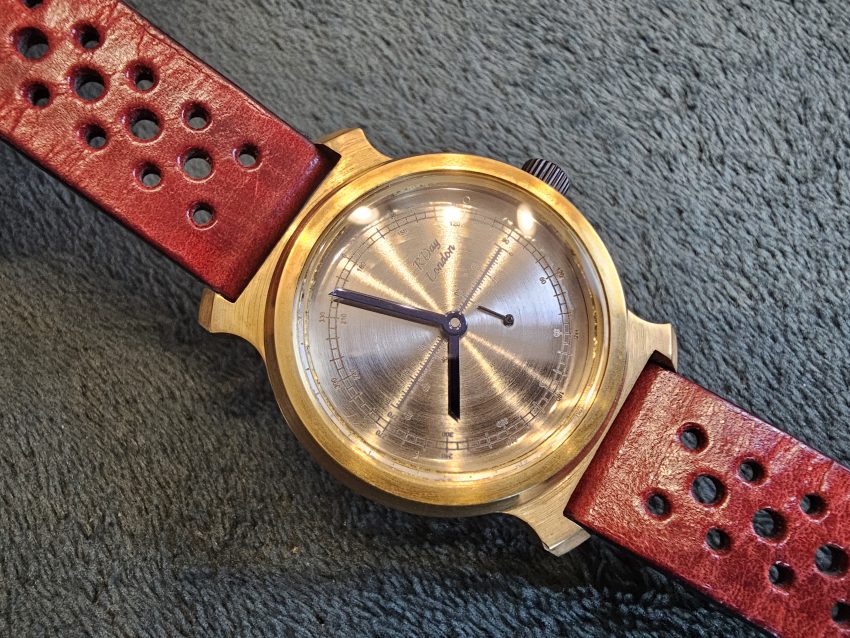
When it comes to a watch like the Astro by R. Day Watches, looking at it is almost like looking at a Rorschach Test. By that, I mean you can almost see what you want to see from it. Those of you with a more artistic, romantic personality will see the history of it, a backstory that speaks of near-tragedy and an artisinal quality. Hell, if I was marketing it, I’d be leaning into that all day and it’s an absolutely valid way of looking at the Astro but there’s a stark practicality to it too and what’s been interesting for me at least, is how it subverted my whimsical first impressions and instead delivers something that’s just a lot less emotionally complex than you might first think.
The first hurdle when evaluating the watch is figuring out what type of watch it is. You know: tool, sports, dress and so on. It’s not a tool watch. There are no clever complications on there. It’s definitely not sports. You’re not going diving with it. It’s legible, but you’d never call it a field watch. It’s showy, but it’s not thin enough to be a dress watch.
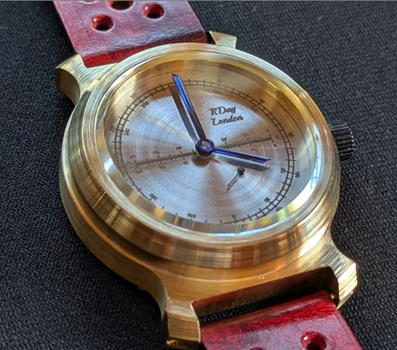
It’s some other sort of thing. I mean, just look at it. Concept watch? Enthusiast watch? Artistic watch? I don’t know. None of them quite fit. It’s challenging, but it’s not weird. It’s dramatic but not uncomfortable. I think we’re just going to have to dig into this one and figure out what you see. A quirky dress watch? A steampunk concept watch? The abandonment you felt when Dad left? Who knows.
Whatever it is, the Astro is a handmade watch, crafted in Richard Day’s workshop. Once a space where he made traditional-style telescopes for amateur skywatchers, he repurposed it to make watches back in 2018. Well, not watches but rather a watch. Just to see if he could do it. We’ve got an interview with the man himself that will follow this review eventually (it turns out that we’re both a couple of chatty Kathys and so it’s going to take a fair amount of transcribing to get it to sub-War and Peace length) and while Richard’s health issues at the time make for a great story about changing lanes (he survived a heart attack right there in the Snipers’ Alley that is being a man between the ages of 45 and 55), making a watch was also a pleasant change from making telescopes but without the need to reinvest in too much new gear.
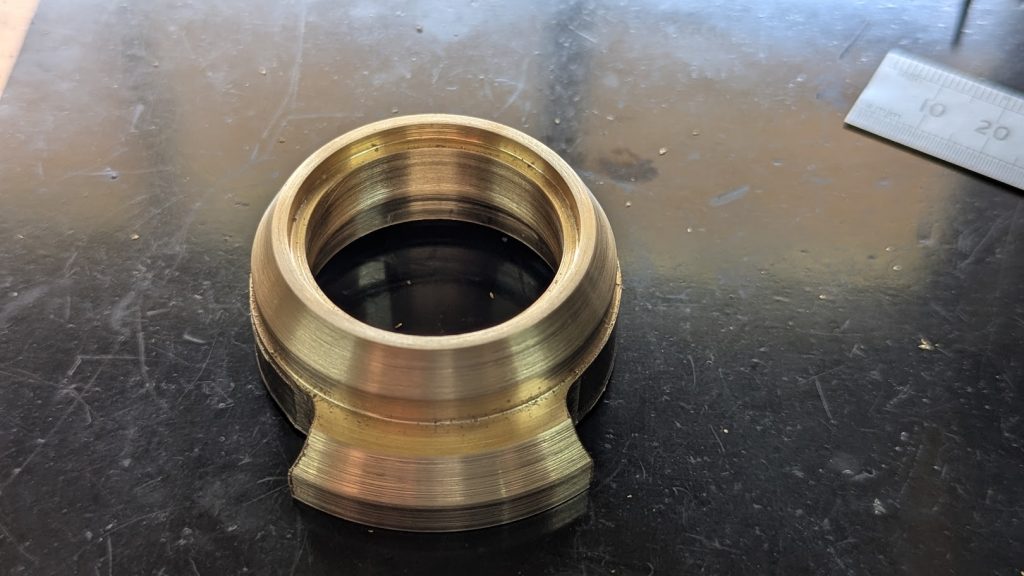
Richard wasn’t a watchmaker but rather a hobbyist machinist, happiest when carving out precision instruments from brass and aluminium, and while we normally look at the dial of a watch in a review first, you’ve got to start with that extraordinary brass case.
The main body of the case is the widest part, solid and substantial and made from a single piece of brass. That tapers in with a little chamfer into a slightly smaller vertical section before sloping in to the top. That’s five sections, a veritable brass Vienetta (ask your oldest English friend) for your wrist. The brass catches the light well enough to give each section some contrast, too, and, as a feature, not a bug, it patinas its way to a unique finish over time. The more you expose it to oxidisation, the more character it develops, but if you want it to go back to its default shine, just polish it. Ask your nan about brass ornaments, they were the rare drop trainers (or sneakers if you will) of their day.
By the time we got our hands on this particular Astro, it had already been around the review circuit and was starting to show the effects of this patinaing (oh shit, spellchecker cleared that one right away) and it looks great. Now this is where the sentimental vs. practical side of the watch swings to the former. I usually hate all that bullshit about ‘every mark tells a story.’
Yeah, that mark is you accidentally scuffing your watch against a door frame. That’s not when you fell over while snowboarding, caught it while summiting a mountain or had to fight your way out of an illegal casino under a speakeasy. That’s where your dog made you trip on a pavement, and you stacked it in front of a group of baying schoolkids who called you ‘bare chief.’
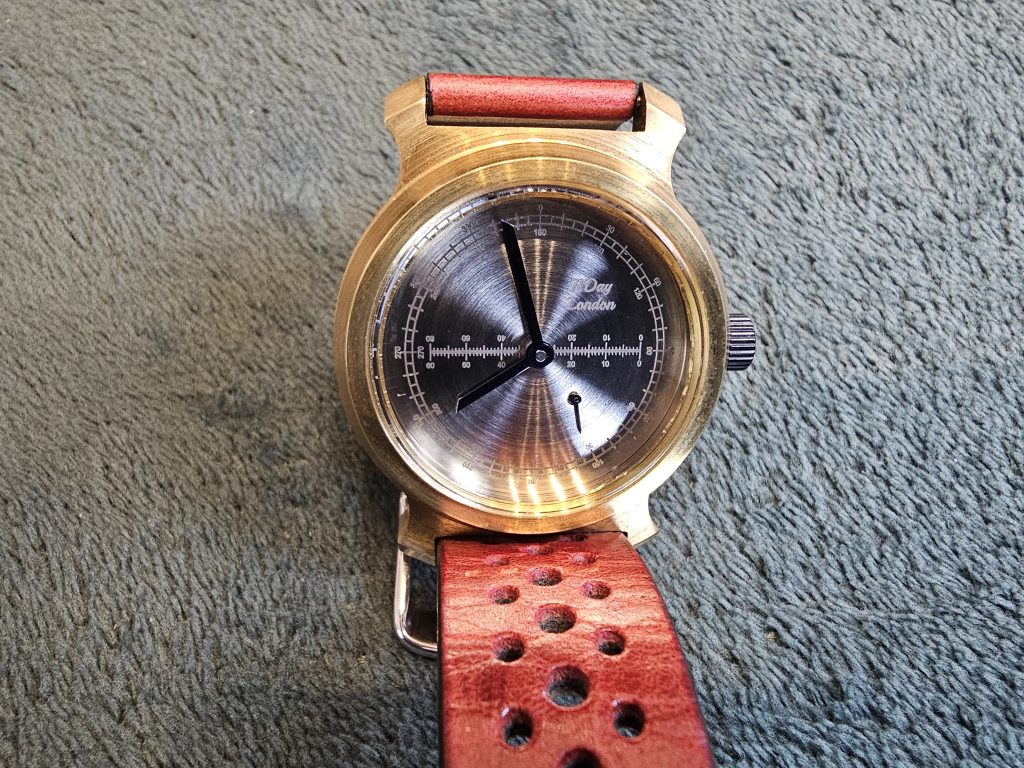
But here, it’s a gentle change in character over time. Evolving slowly but still with purpose. That purpose being to not look exactly like any other Astro that you might see out there in the wild or, most likely, in a UK watch show. Seeing it now, rather than fresh out of the showroom, is ideal as we’re able to see what one these watches will become and that’s pretty exciting given that most watches essentially deteriorate over time rather than improve.
But the practicality of how the watch was created is the part of the story that we like. An example being the lugs, which have a rather unique shape to them. It turns out that’s more down to the available 10mm bit that Richard had in the workshop, but it is something of a happy accident, as it gives the watch a really unique footprint. Initially, Richard was going to take them out, but I think we’re all relieved that he grew to really like the curved lugs.
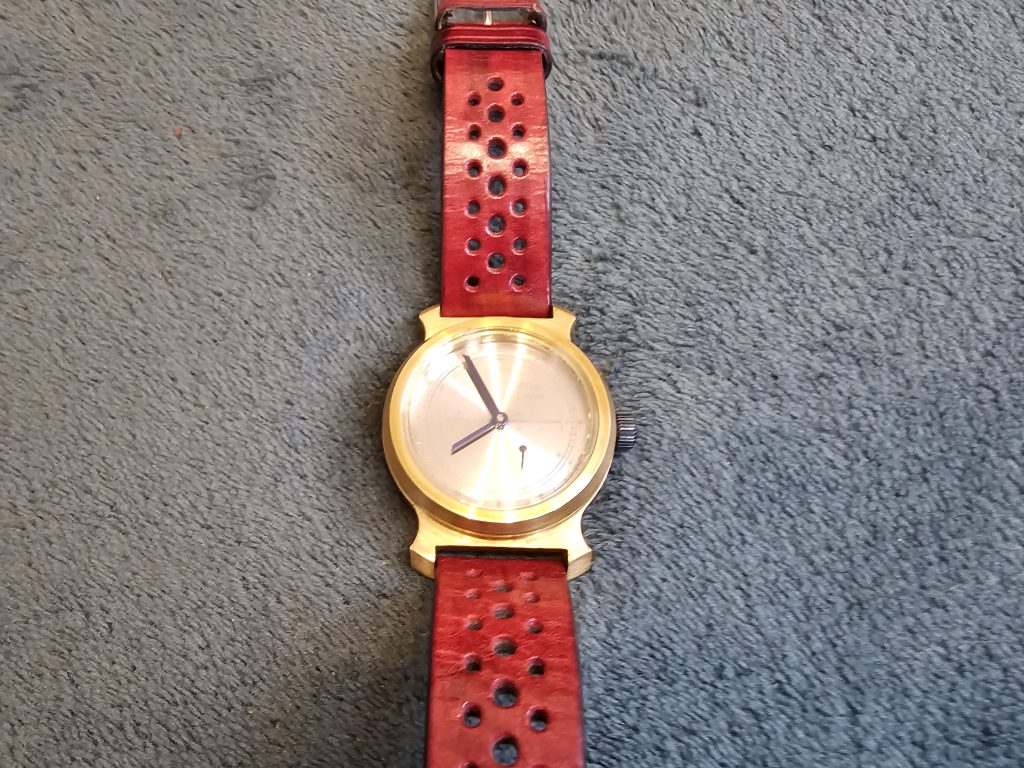
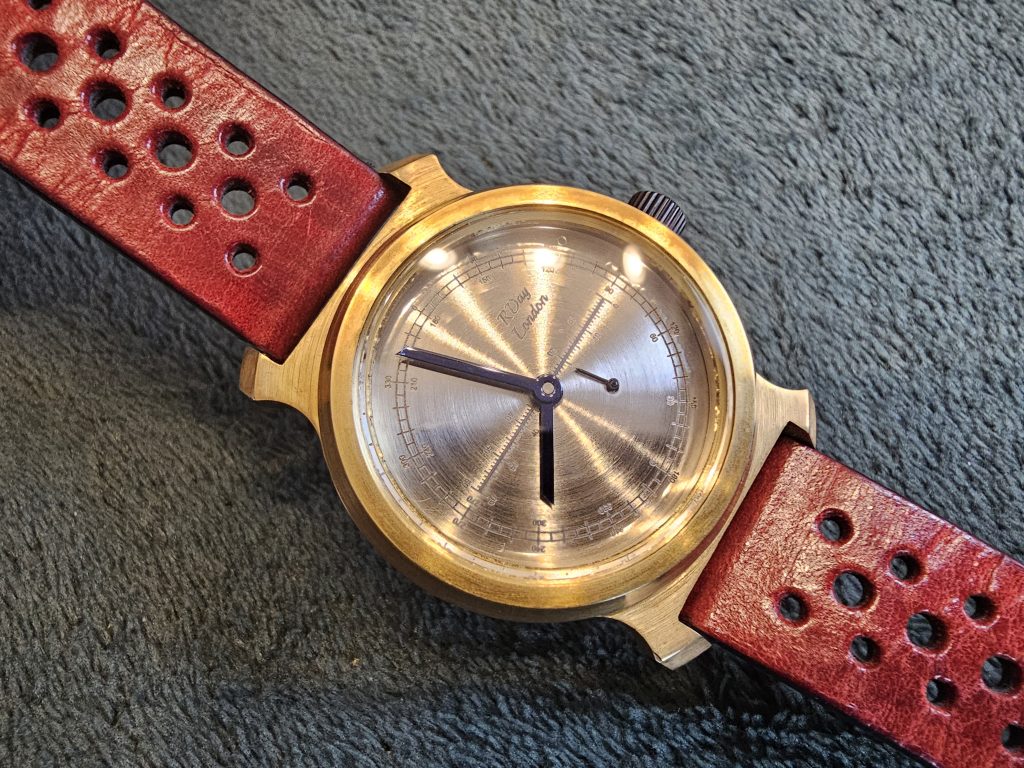
The dial is interesting, but in a whole other way. The silvery radial shine of the aluminium is slightly at odds with the warm brass tones of the case, but it works, neither being too bold to create a true clash. And the combination speaks to the heritage of the watch itself, handmade in a workshop from materials picked to do the job they need to do.
The design of the dial reveals a ton about the watch. The standout design element is the engraved replication of an astrometric eyepiece, or rather the reticle (a built-in pattern etched right there on the glass). Lines and scales that help astronomers measure distances between stars and track the motion of asteroids and comets.
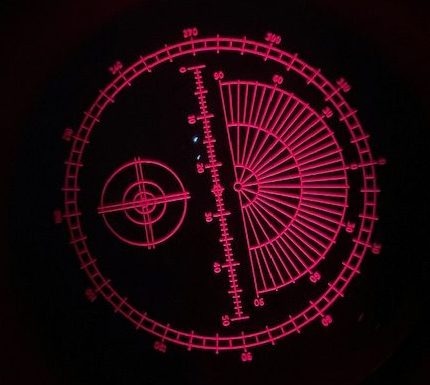
Richard has kept two of the elements of it (two are removed for clarity), with the horizontal scale acting as pure decoration and the outer ring scale functioning as the minute marker. Well… sort of. It is divided into twelve, mapping onto the standard five minute markers perfectly. But the original eyepiece reticle subdivides those into sixes. It would have been the easy option to modify that design, subdividing them so that each minute marker was perfectly laid out, but where’s the fun in that? Richard has kept it in sixes. It doesn’t affect the basic readability of the watch but adds a heap of quasar-spotting quirkiness to the whole thing. Of everything on the watch, that’s the detail that tickled us the most, and it shows how Richard’s matter-of-fact mindset works. Why compromise details to fit some sort of expectation? Nothing else about the watch does, so why should the dial?
That theme continues. Big time. The logo placement is up there in the top-right of the dial. It feels like that demands an explanation, but as Richard says, it was a ‘why not?’ feature. He tried it, he liked it, and that’s how it is. It wasn’t his grandfather’s favourite place on a dial or a directional nod to Richard’s birth country, Canada. All he knew was that he didn’t think it needed to be where everyone else’s logo is.
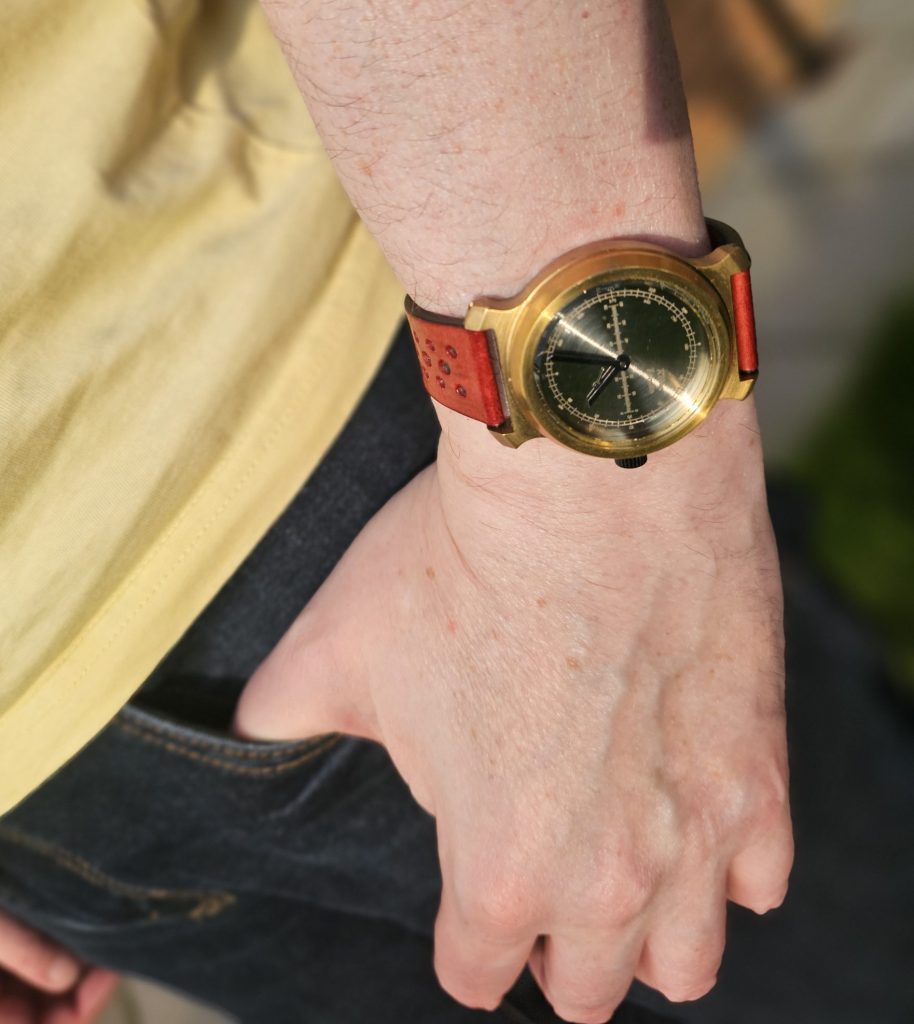
And if that’s in any way controversial, then you’re not even ready for the watch’s only complication, being a small seconds dial. That’s tucked away at 4:30 and doesn’t even sit in a subdial. It’s almost as if its main purpose isn’t to measure seconds but rather to just show you that the watch has enough power in reserve to keep ticking. It’s audacious in its minimalistic simplicity. He’s even used a black hand there, as opposed to the dark blue hour and minute hands. It could only be more understated if it were in silver. It’s saying it quietly, but it’s saying everything you need to know. This watch isn’t trying to be clever, it’s just being what it is. Take it or leave it, but if you take it, you’ll be able to chew people’s ears off about why it’s so very cool.
Speaking of those hands, they have super-unusual tapered hands. The true time-telling mark is mid-way between the high point and the lower edge as opposed to, let’s say, almost every other analogue watch in existence. As John Connor said, “Are we getting it yet?” This is a watch that hasn’t been focus-grouped. The only workshop this has been in is the one with a lathe in it. That said, seeing the lower edge of the hands against the outer scale is a little tricky in some conditions, so maybe don’t use this watch to time anything that requires a ton of absolute precision.
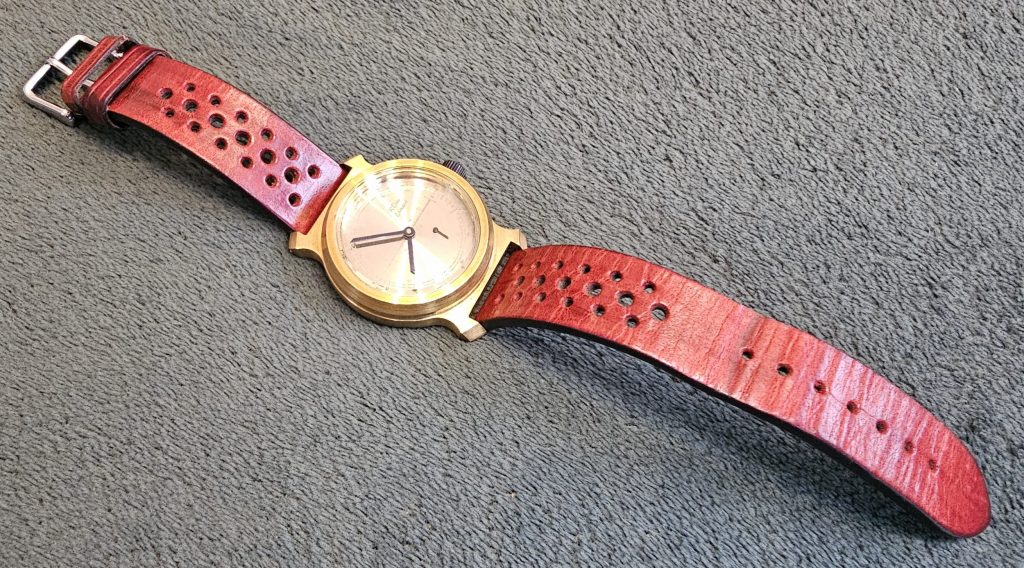
There’s no lume, which is kind of odd for any sort of space-themed watch. But it makes sense here. This isn’t about space after all. It’s about the tools that people used to use to discover space, before technology did all the hard work for you. This is about traditional instruments and techniques rather than far-flung galaxies and nebulas.
A real surprise with the watch is in how wearable it is. I assumed it’d be far too chunky for my skinny wrists, but the 39mm case (50mm lug to lug) is perfectly proportional. And if you’re a bigger-wristed guy, the 13mm width gives you that extra presence that you might desire. Even then, it’s still very wearable with the extra height only offering visual interest rather than any inconvenient bulk.
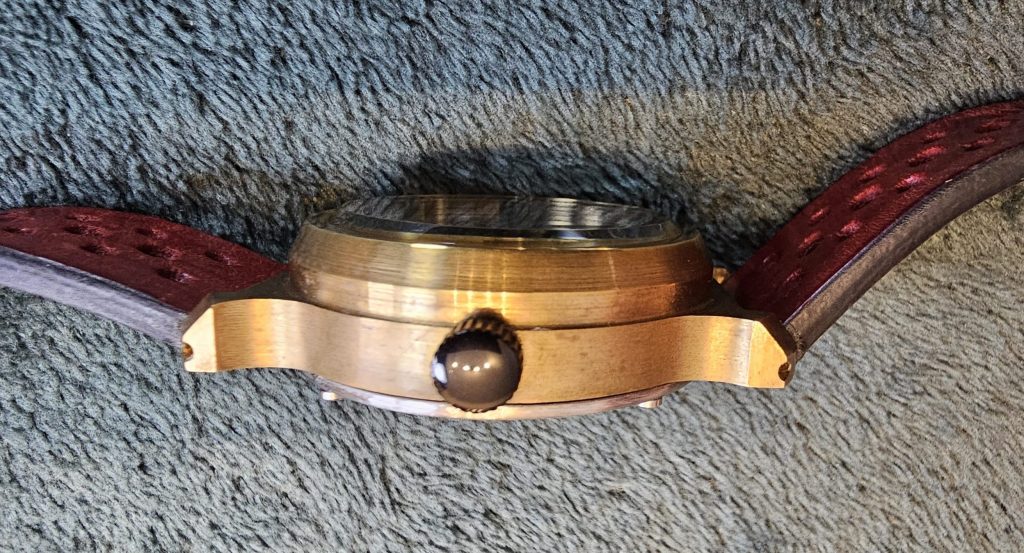
An additional 2mm is added thanks to the sapphire crystal, which sits proudly above the main body of the case. With its faceted edge, angled almost at 45 degrees, and uncoated glass, it makes you think of the eyepiece of a telescope. A feature that stands tall rather than being set into or below the case. The polished edging certainly plays with the light, though, making side views of the watch a particular joy, and while there is no anti-reflective coating, any light getting through tends to actually help highlight the details of the watch, creating light and shade contrasts to help the details pop.
Initially, we weren’t too sold on the back of the watch, which is essentially a plate of stainless steel that has four screws that aren’t countersunk. It looks like it should be uncomfortable, but actually, it wears just fine. The caseback is pretty stark, and we’ve been spoiled by exhibition casebacks, engravings and cushioned cases, so we weren’t really feeling it. But then we asked Richard what the numbers on the back mean. 25925. This is the 25th bronze case that he made. And the watch was finished in September 2025 (9/25). And with that, we were even more sold on the watch.
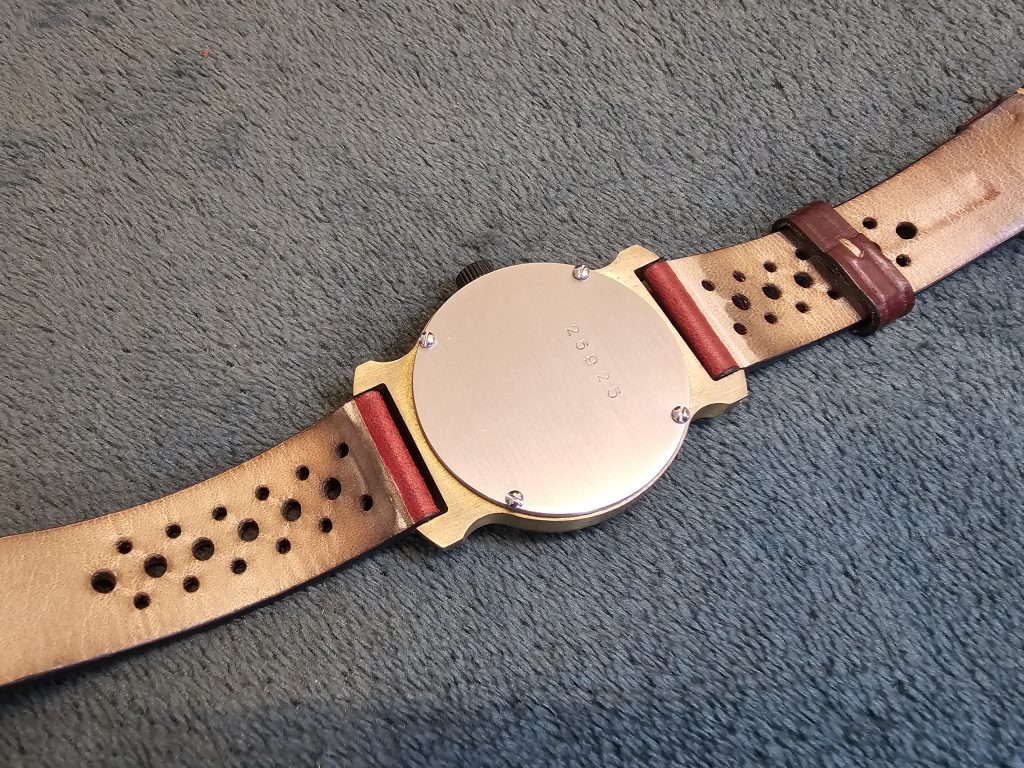
It would have been easy to put a meaningful date in reference to Richard’s second chance at life or a pithy quote about the stars and keeping things in perspective. But no. 25th case. 25th of September. Details that actually tell a story about the watch. It’s more like a birthmark than a flourish. Again, practical, not sentimental. This is a watch made by a machinist in a workshop, using the tools at his disposal and trying out visual ideas that a) work and b) that he can pull off. But by iteration and some inspiration, he’s created a watch that looks truly unique and yet isn’t a freak show. It’s a watch that looks like what it is: a watch. But it doesn’t look like your watch. Or his watch. Or her watch. But it’s not a Mr. Jones visual experiment. It’s as practical as anything else you can buy in the high street. It’s just different. A product of tradition, but also of right now.
An unremarkable, unsigned black crown is the only letdown, really. It’s a minor niggle, but it can seem a little tacked on; it is a stock part after all, and it doesn’t screw down so you’re limited to just 3ATM water resistance (30 meters but less in real life). Of course, if I see you taking this swimming, I’ll jump in and fight you on general principle, you monster. And I swim about as well as a table, but I’ll still beat you in front of your woman.
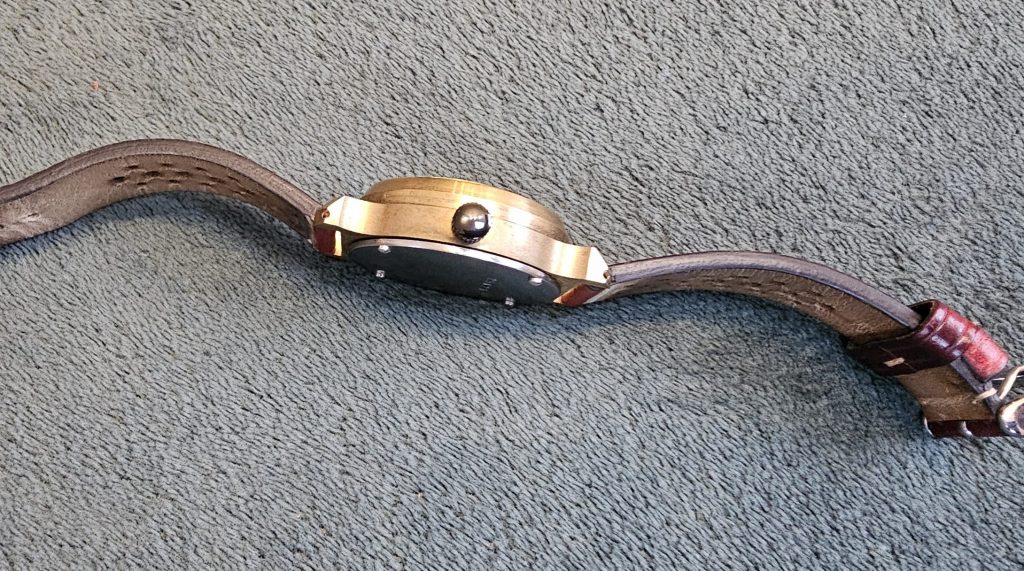
The crown operates the Miyota 8245 movement. A fairly unremarkable, entry-level workhorse. There’s not much to say about this one. It’s a simple movement that just has hours, minutes and the small seconds (all 8245s have this complication at 4.30). It’s an automatic movement offering a power reserve of 40 hours, and it hacks (the seconds stop while setting the time).
There’s no ghost date, thankfully, and while you can hear the rotor, you do have to be shaking the watch next to your head to do so. These sweep at 21,600 vibrations per hour, but that seconds hand is tiny and so you won’t be pining for anything smoother. It is very serviceable, but beyond that, there’s nothing special about it. In a normal watch, this would drive down the price, but you’re paying for the craftsmanship of the watch here, not the movement inside.
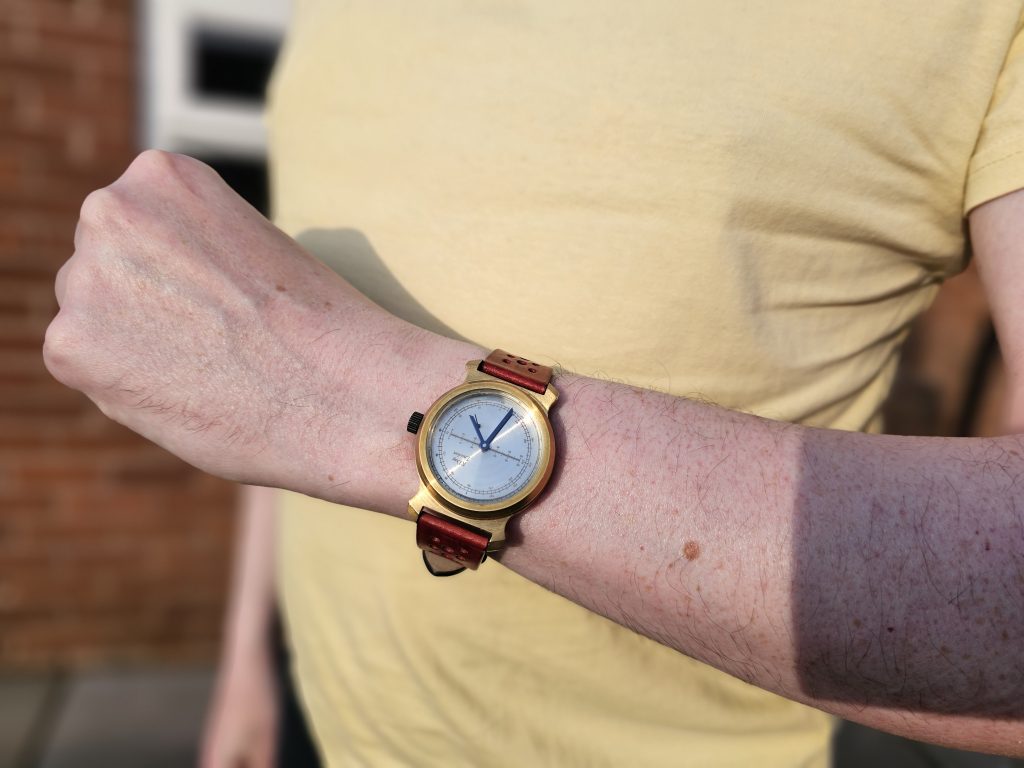
The watch also comes on a leather racing-style strap. It’s not made by Richard Day, but it does pair excellently with the watch thanks to its rust-coloured, grainy finish. It’s quite beautiful, but it was one hole short of being a perfect fit for me. So if your wrist is under 6.5 inches, you might be looking to swap it out.
I’ve lived with this watch for a few weeks now, and it’s been a bit of a revelation. Microbrands are happily dishing out more traditional shapes but in all manner of exciting colours and finishes, and we love our bright red Revelot, our abalone Phoibos and the shimmery tesselations of our Henry Archer. This is nothing like those watches but it’s nothing like any watches. Where a slightly misaligned index on another watch sends us into a Jack Nicholson in The Shining mental spiral, any imperfections here remind you that this watch was made by a guy. A guy in not-quite-Wimbledon, in his home workshop. Not in a Chinese factory, not with computer-aided machinery. Each watch he makes matters. This watch matters. And whether it links you to your own recent history, the birth of the universe itself or just speaks to your own practical nature, this watch tells a story. And it’ll be too busy looking good while doing it.
Pros:
+ Truly unique design
+ Brass case creates a unique, attractive patina
+ Confident presence without being large
+ Handmade
Cons:
– Stock crown feels a little basic and doesn’t screw down
– Caseback might be too plain for some
– Brass isn’t the most durable material
– Unremarkable movement
– No lume
Summary:
A great mix of traditional engineering and non-traditional watch design, the Astro is one of the most visually interesting, and attractive, pieces you can buy and one that that is truly unique in a scene that can often chase trends.
JUST THE FACTS
Availability/Options: The Astro is available at Richard’s website for £960 (+ shipping). It is truly handmade though, so stock levels can vary. An aluminium version is also available for the same price.
Brand: R. Day
Model: Astro
Style: Don’t ask!
Case Size: 39mm
Movement: Miyota 8245
Material: Brass case, stainless steel caseback.
Band Width: 20mm
Band Type: Leather bracelet
Price: £960
Declaration: I received this watch on loan from R. Day Watches. However, no payment has been made on either side and this review will be published without sharing with the manufacturer. Any questions? Comment below.
Love the review! I own an aluminum Astro and refer to Richard as a workshop-crafted watchmaker. The watch type is a UFO, Unidentified Focal Object!
Thanks, Brad. I really appreciate the comment. The aluminum Astro looks lovely also. UFO… love it!