
Look before you Philippe.
Furlan Marri is a Geneva-based watch brand that initially started as a microbrand (outsourced manufacturing, Kickstarter launch, no showroom) that exploded onto the scene back in 2021. And by exploded, we mean they went full Enola Gay over Hiroshima on the whole microbrand industry. Their initial funding goal was met faster than if someone resurrected Freddie Mercury, Jimi Hendrix and David Bowie and organised for them to do a one-off concert via Ticketmaster. In a caravan.
35 seconds to hit 75000 Swiss Francs (about £68k). You could buy a two-bedroom terrace house for that. Albeit in Sunderland. But bloody hell. That’s a level of excitement usually only seen in Taylor Swift fans and people who queue up for plastic Swatch collaborations.
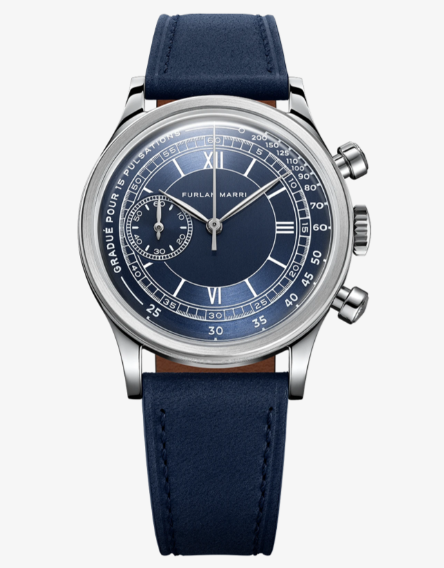
Brand founders Andrea Furlan and Hamad Al Marri were onto a winner, and they knew it. They started with their simple Chronograph Reference series, which was somewhat inspired by the Patek Philippe Reference 1463. Roman numerals, clean lines and the chronograph features that we still see today. The bi-compax layout, the tachymeter dial. And they were praised universally for bringing that vintage Patek look back but at a much more affordable price. Swiss-designed but Far East manufactured, it was a taste of Swiss luxury on a budget. Like a Moonswatch but, and this matters, actually good.
Last year, Furlan Marri released the Ardesia Blu (Ref.20203) in June (alongside the salmon-hued Sabbia Rosa), officially making meca-quartz a permanent feature of their catalogue. And while they are known for their high-end Swiss mechanical watches, using premium movements like the La Joux-Perret LJP-G100, they’re also smart enough to remember that there is a market out there for quality budget pieces.
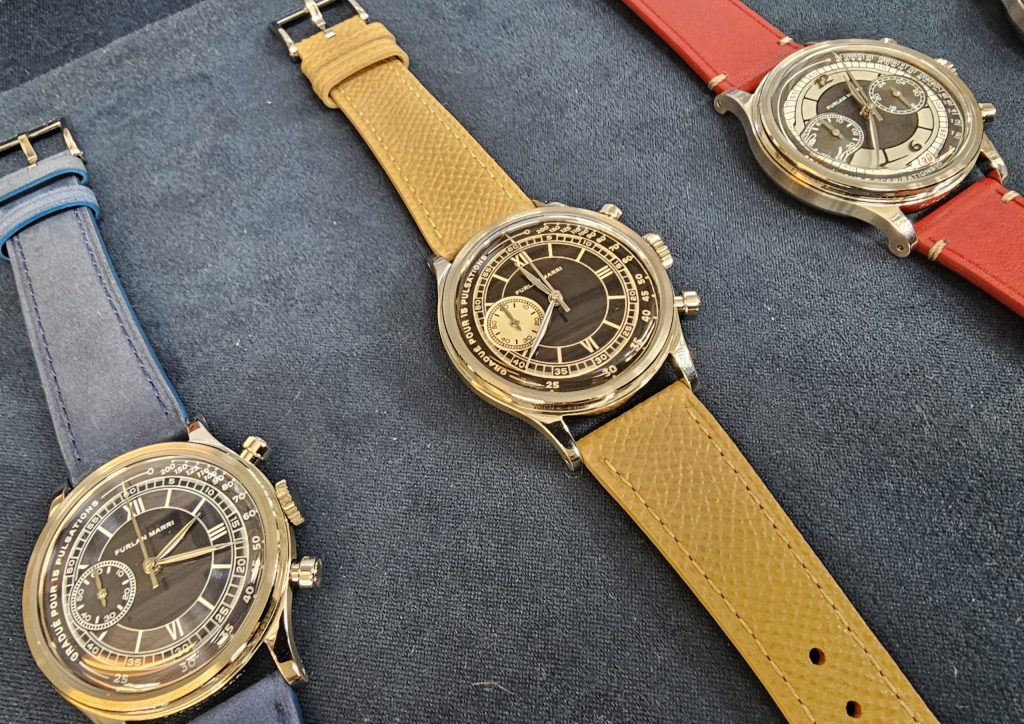
As such, collectors looking for a simple but extremely swish, 1463-inspired look have been flocking to these watches and when we met the brand at Hands-on Horology this Summer (in particular their gem of a PR rep Camille, who was one of the friendliest faces among all the brands there), we too were impressed with what we were seeing. But first impressions don’t count for much. What we prefer is punishingly detailed written reviews that really dive in, and if you’re here, hopefully you feel the same.
This watch (the aforementioned Ardesia Blu) was sent to us on loan by Furlan and Marri’s press department (definitely not a microbrand!) and arrived in a nice pouch, but without a box. So we can’t speak to the unboxing experience. However, we understand that you get a rigid, vintage-style box, art-deco styled, with a thick outer cardboard sleeve. The watch comes in that pouch, which is a win because standard pillows are rubbish and often end up with the watch bouncing around inside the packaging as the local postman uses the box for a quick game of keepy-uppies. If you ever bought CDs or DVDs just to find the disc freely flapping around off the spindle, you’ll know the pain.
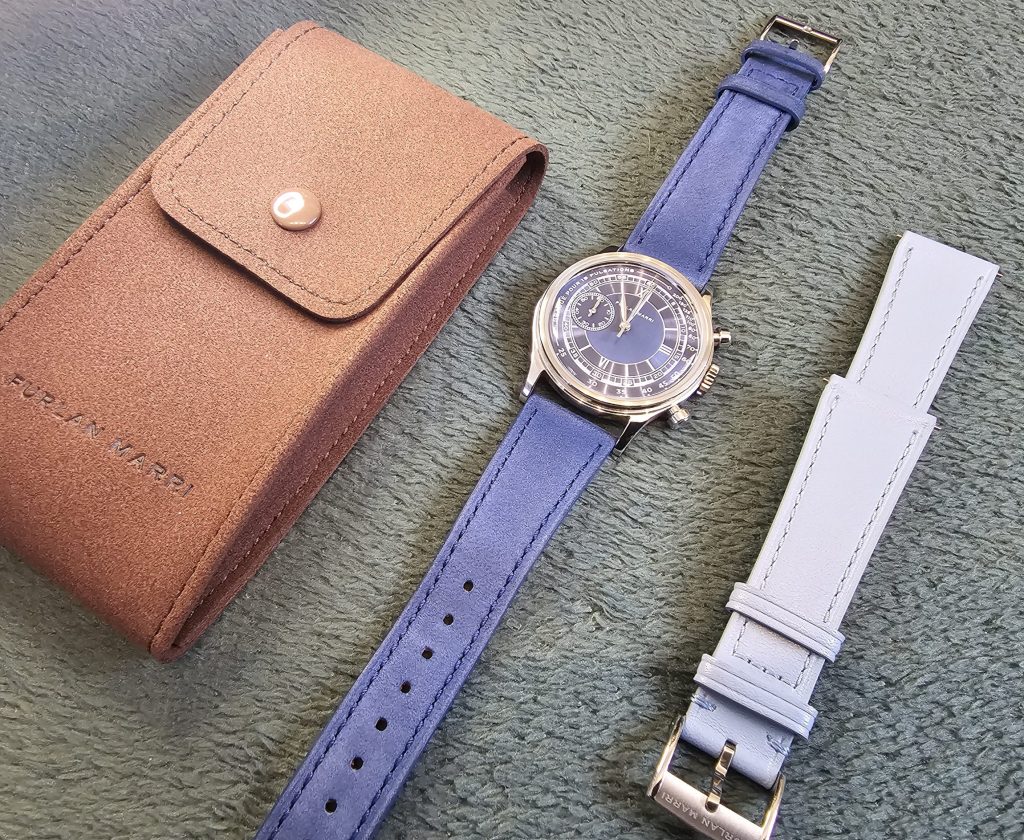
The Ardesia Blu also comes on a strap, with an alternative squirrelled away in the box. A certificate, instruction manual (with some historical information about the watch’s ‘Tasti Tondi’ origins (an Italian slang term that describes the round pushers that operate the chronograph functions) and a branded cleaning cloth.
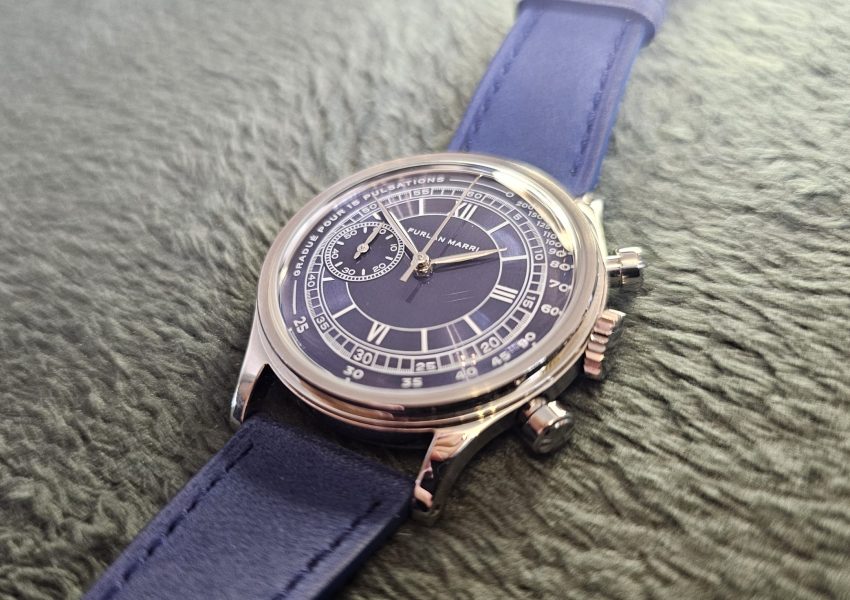
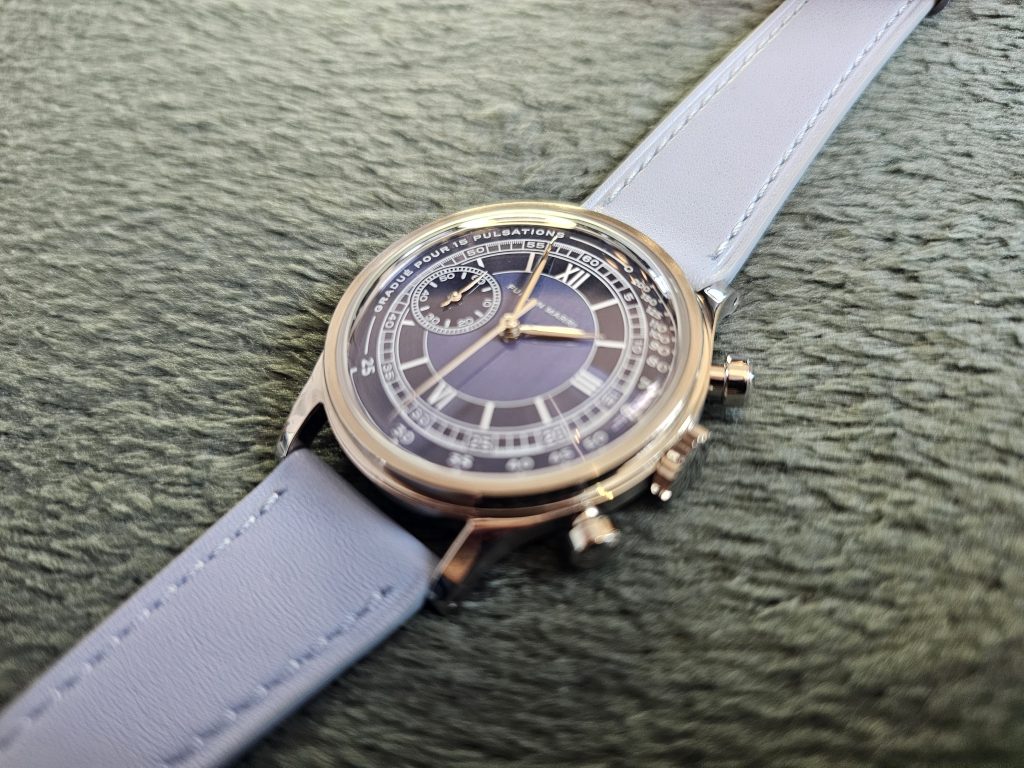
The immediate stand-out feature is that dial, but it takes some absorbing to really get it. On the face of it, it’s a dressy blue dial with plenty of white detailing, but that doesn’t tell the whole story at all (although it’d save us a few hundred words if it did).
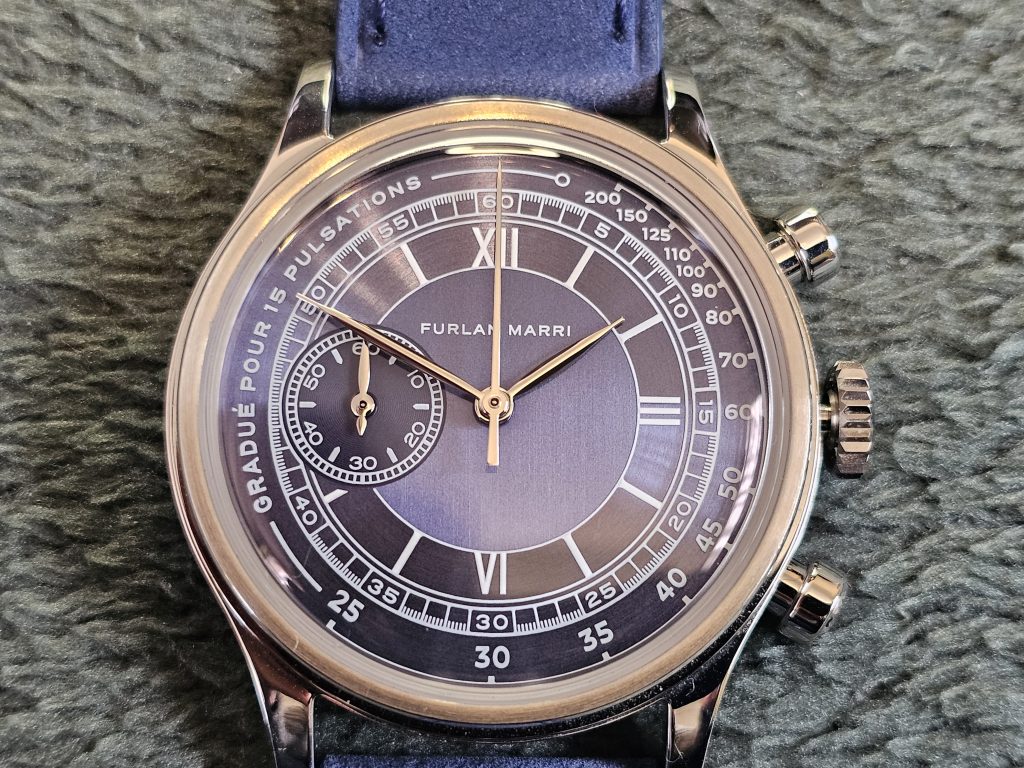
It’s best to think of this dial in concentric rings. The middle section takes up about half of the radius. A simple blue circle made of a solid brass plate, brushed vertically and PVD-coated in blue. From a distance, it just looks like a filled blue circle, but look closer, and that brushing impresses immensely.
Each zone is separated by a thin white line, and up next is the hour ring. The hour markers at twelve, three and six are stamped roman numeral, giving that vintage Patek look, while the other markers are applied steel baton indices. Behind them, the brushing is switched up to a circular finish, which adds a subtle contrast but plays with the light and seemingly alters the colour of the track. It’s one of the best examples of the finishing and attention to detail. Many microbrands can’t be bothered to contrast the finishing on the case; Furlan Marri do it on the dial. This is where your money is going, and so far it’s worth every penny.
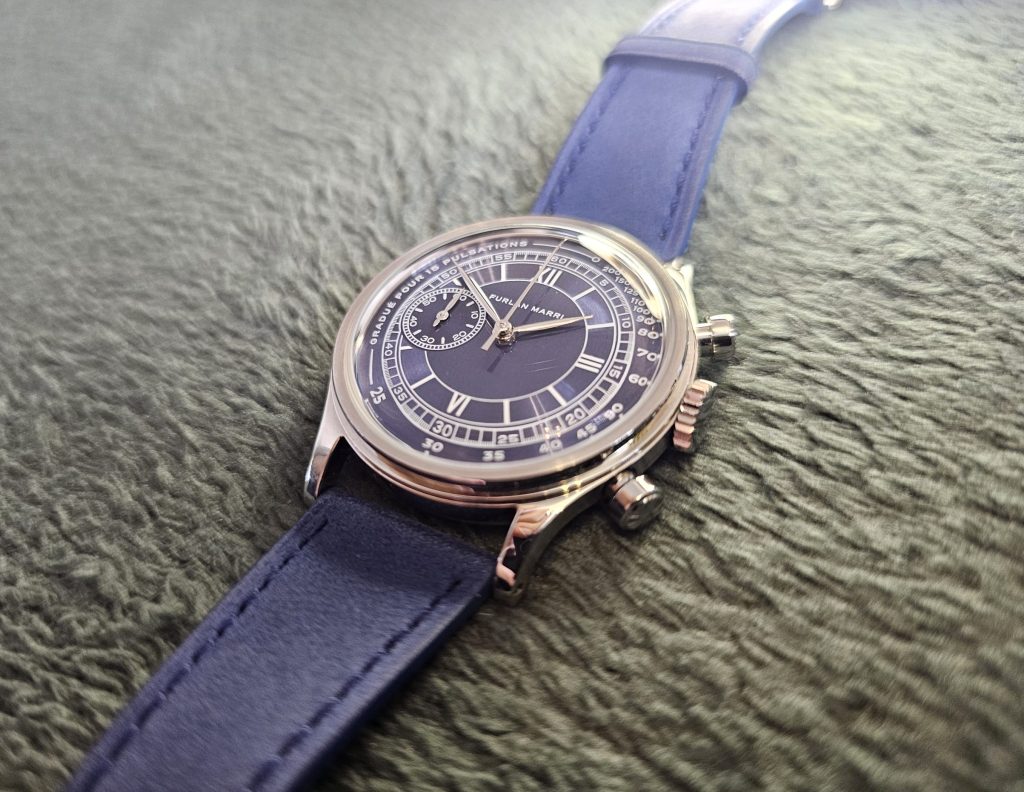
Next up is the minute track. Using the classic ‘Chemin de Fer’ “railroad track” format, the detail here is astonishingly intricate but also clean. Each five-second marker is a printed arabic (read: an English number), you then get sectors for each second with sub-divisions because of the 5 Hz sweep of the chronograph hand. So if you’ve got an insanely fast index finger and cyborg-like reflexes, in theory you can get astonishing accuracy from the chronograph function.
The really cool detail here, though, is that all of that is double-printed. White ink is pushed onto the dial with a soft stamp that moulds to the shape of the dial plate (which isn’t completely flat thanks to the brushing, borders and recessed sub-dial). It is then done a second time. This results in the ink sitting very slightly above the dial, making it catch the light directly while giving it a sharper look. It also appears to add some 3D depth to the watch, especially between this zone and the outer one, even if that’s something of an illusion.
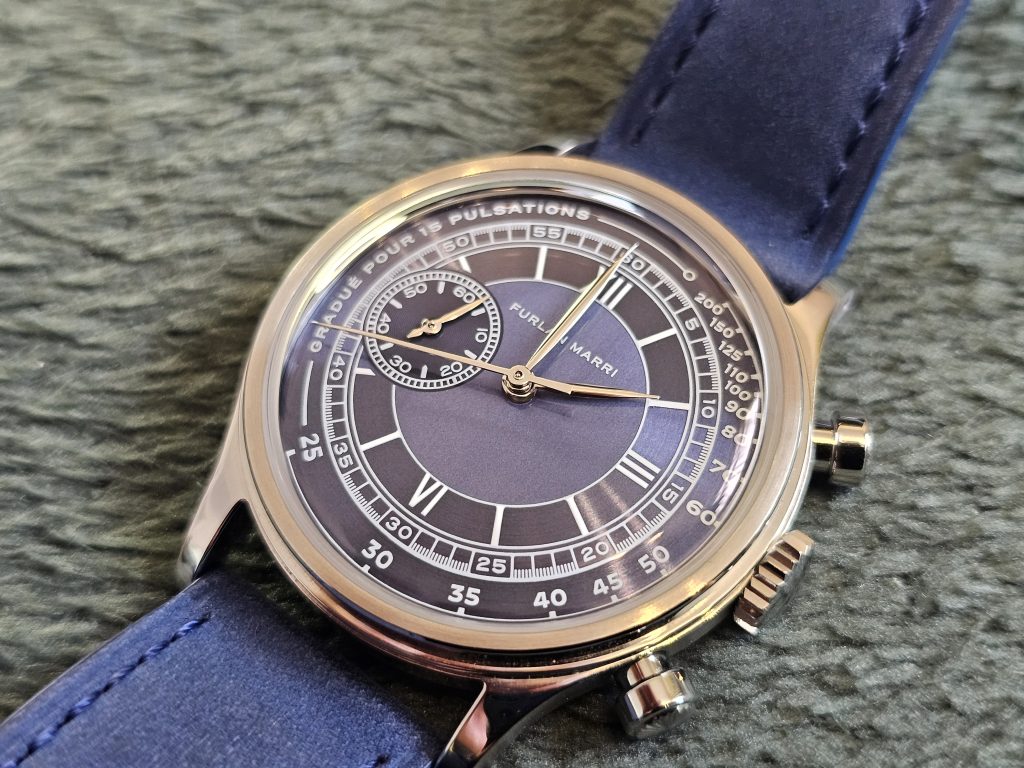
The outer section is also suitably cool. The original Patek 1463s were mostly tachymeters, that old favourite complicated scale that allows you to measure speed based on elapsed time over a known fixed distance. Which, along with fondue sets, novelty socks and Coldplay ticket hotlines, is something that most people never use.
However, twenty or so 1463s had pulsometers instead. Often nicknamed ‘Doctor’s Watches’ these printed scales were instead designed to measure a person’s heart rate in beats-per-minute, but without having to wait a whole minute.
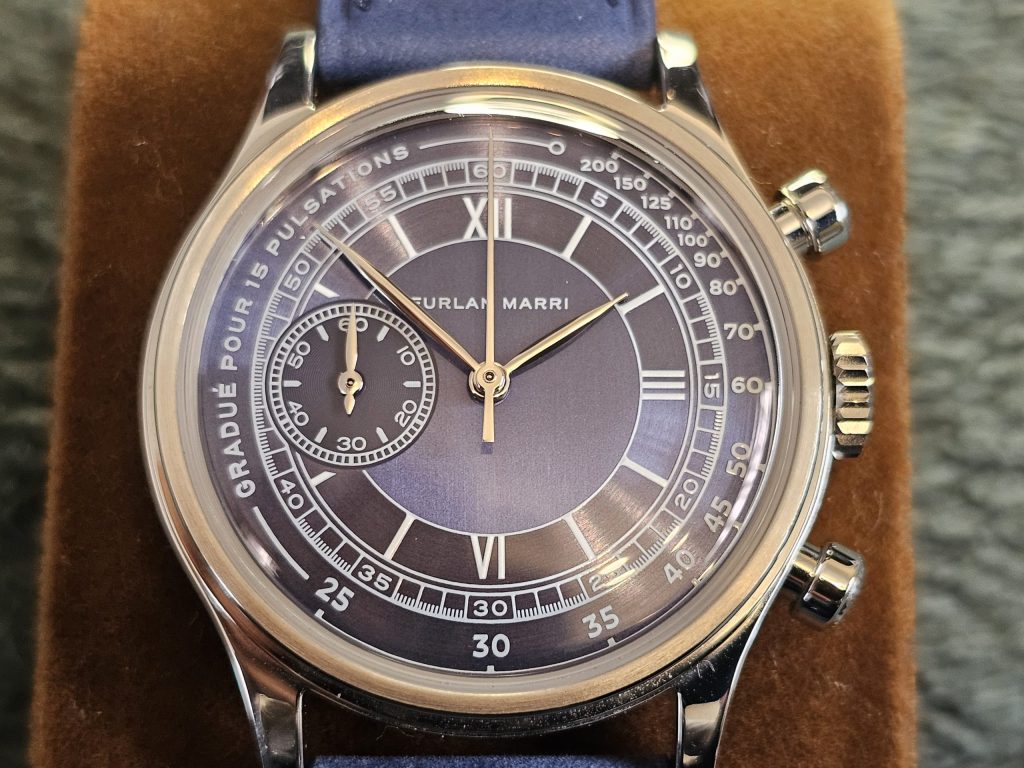
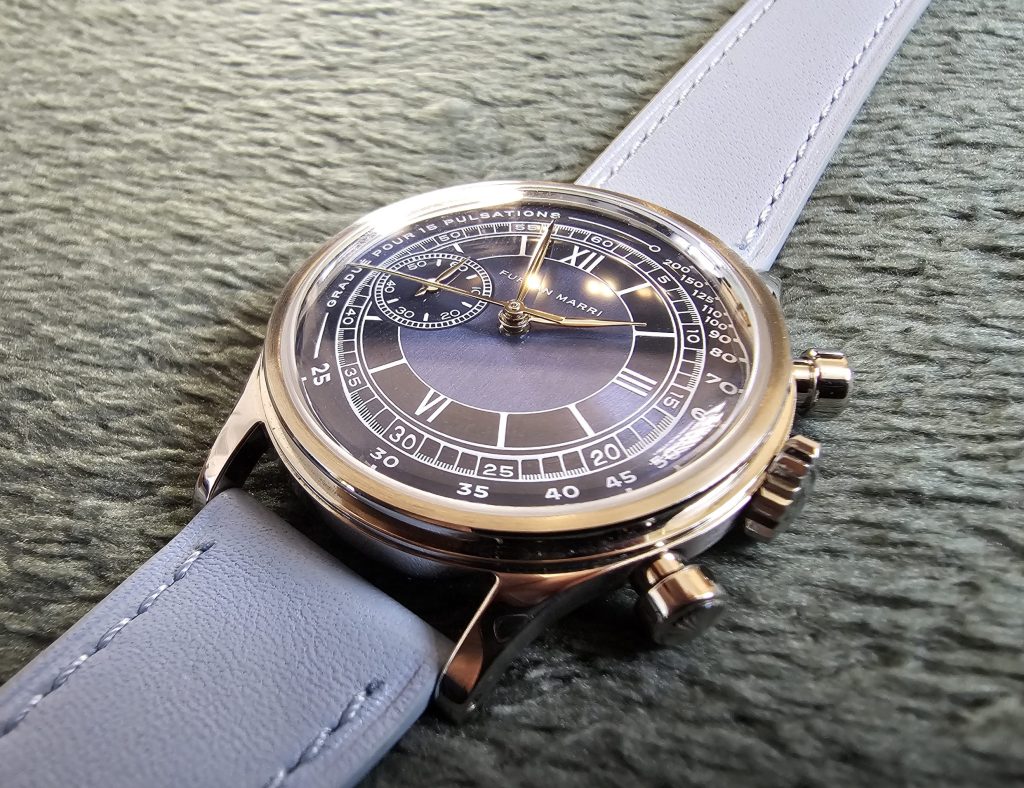
The Ardesia Blu is calibrated for 15 pulsations, as indicated by some text it the top left corner of the dial that says “Gradué pour 15 pulsations”.
If you’re a doctor, you just find your patient’s pulse, start the chronograph, count to fifteen, stop the chronograph on that 15th beat and read the dial. Whatever number the chronograph hand is pointing to on that outer scale is their heart rate. Measuring your own requires you to take the watch off so that you can operate the pusher with your left hand while trying to find your pulse with the right (at one point I started wondering if I was Bruce Willis in The Sixth Sense because it took ages to find mine) or by playing some serious finger Twister.
Is it something you’ll use often? Probably not. Will you use it at least once, unlike a tachymeter? Probably yes. Is it infinitely cooler than a tachymeter and speaks to a little bit of Patek history? Absolutely. We’re super into it.
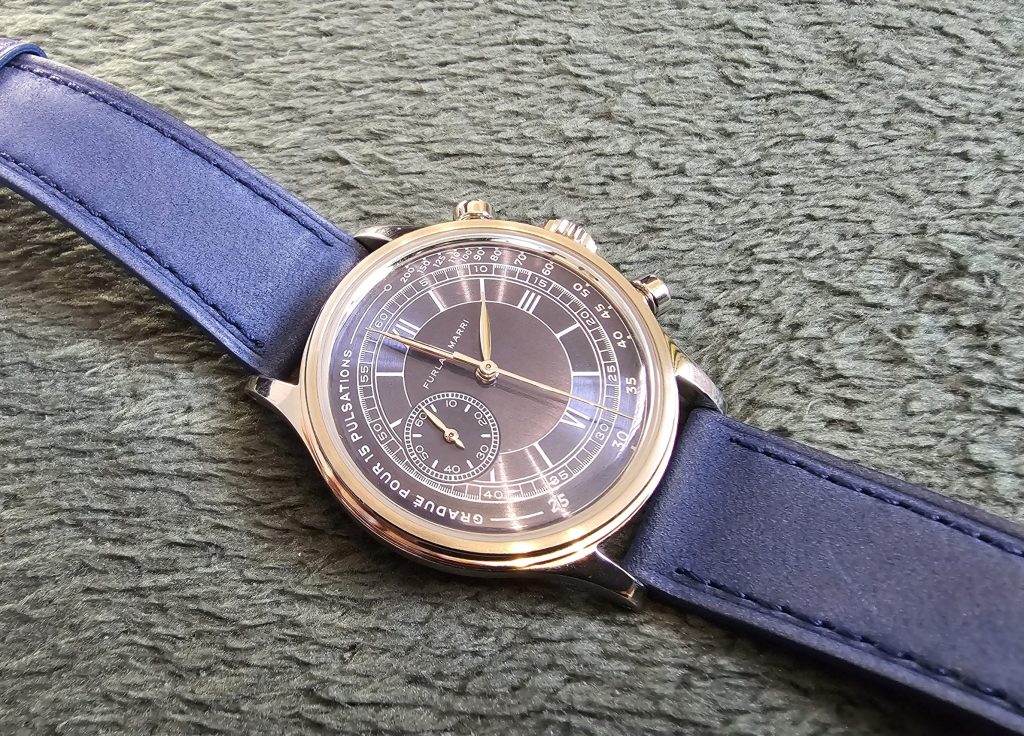
Recessed between the inner zone and the hour track, at the 9 o’clock position, is a solitary minute-tracking sub-dial with every fifth minute marked in Arabic numerals, with a second track around it. This tiny dial is only in use when operating the chronograph and isn’t polished, giving it a darker blue contrast compared to the zones around it.
The hand set is also yet another chance for the watch to reveal a hidden flourish. To the untrained eye, they just look like a standard set of leaf hands (they widen in the middle before tapering to a point), but they actually have curved tips that follow the curve of the domed crystal. This means that the distortion of the dial doesn’t affect how you read them. You can actually see the curve if you look at the hands from a shallow angle from the side. Does it massively affect the functionality of the watch? Not really. But that’s not the point. The point is that they took the time to consider and execute this little detail, and you had better start appreciating it.
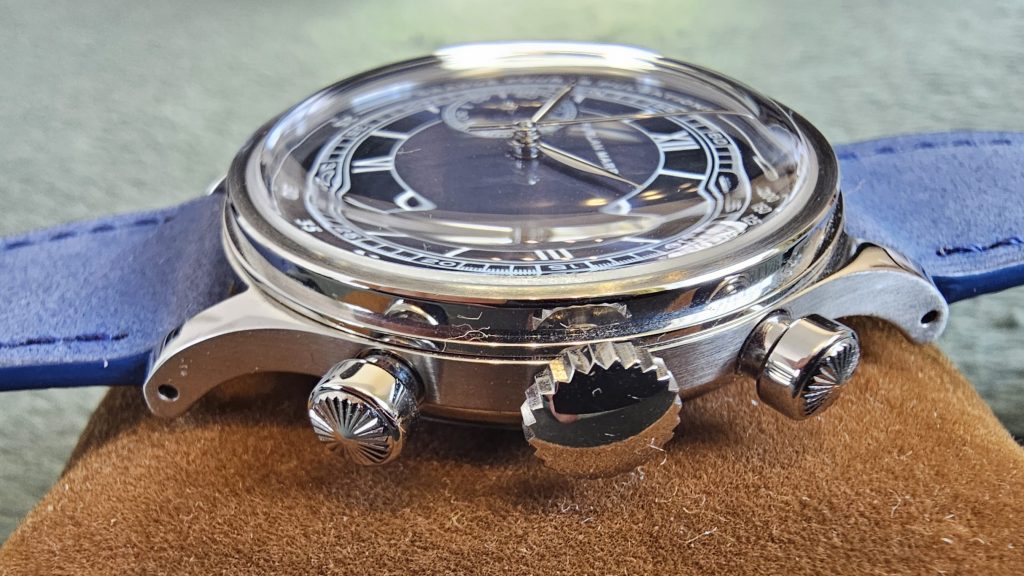
This all sits underneath a domed sapphire crystal, which sits 0.5mm above the case. It has a gentle curve, but the effect is actually quite dramatic. Firstly, you get some real visual distortion of the dial and because the curve of the crystal sits above the pulsometer, when combined with that double-printed minute track, it gives the watch a real 3D effect. Not just layers. It genuinely adds this spooky 3D effect that has you holding the watch up to your eyes at different angles, trying to see if the pulsometer is recessed. We’re still not sure, but fairly confident it isn’t. The height of the crystal also allows light to flood in.
You also get an anti-reflective coating on the underside of the crystal, which actually does a great job of handling reflections, as well as an anti-fingerprint coating above. Someone needs to tell Bulova that this technology exists. The watch certainly doesn’t smudge easily, unlike the Jet Star we reviewed a while back.
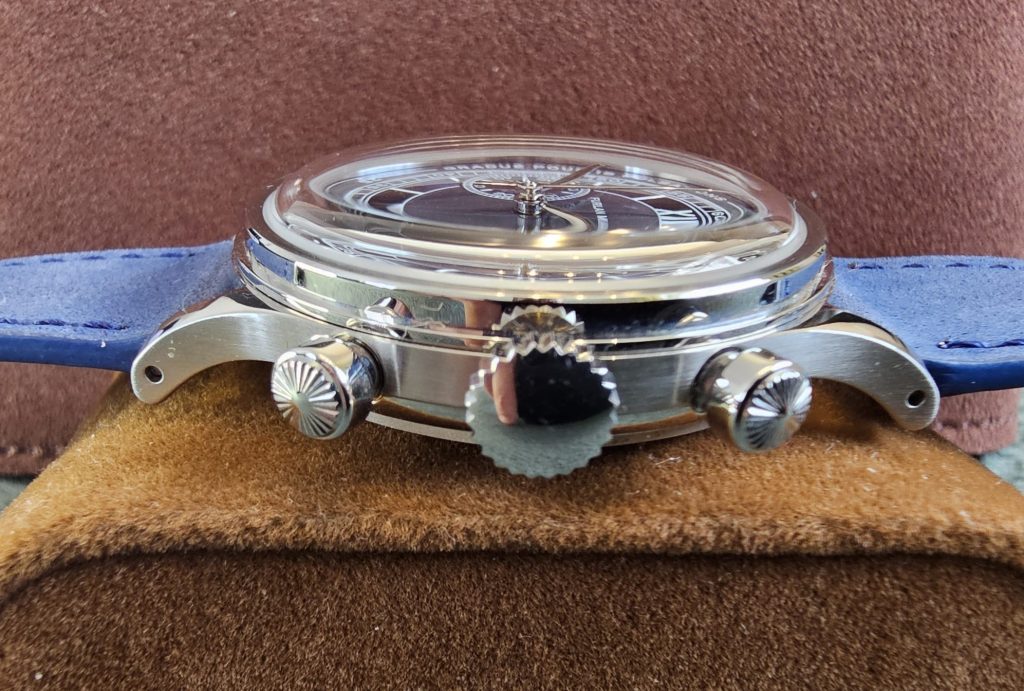
While the dial and crystal are doing a lot of the heavy lifting when it comes to this watch’s appeal, the case is no slouch either. A thin bezel surrounds the dial and has a brushed polish. A tiny chamfer leads down to a mirror-polished side, which steps down to a very narrow section before eventually stepping down to the main body, all of which shares that same full polishing.
That multi-layered shape adds real visual interest while breaking up the height profile of the watch. It just stops it all from looking like a big block of steel. And to break up all that mirrored polishing (which can make any watch look cheap if overused), the flanks of the watch sport a horizontal brushing. Contrast is everything when it comes to us really loving a watch, and Furlan Marri have nailed it here.
It is in this section that you’ll find those ‘Tasti Tondi’ pushers, which feature thick stems and chunky tops which feature sunburst engraving. More unnecessary, but also completely necessary, detailing that we can’t help but love.
The crown is really interesting, aside from the lack of signing or detailing on the face of it. It’s very wide, coming in at 5.8mm in diameter. It’s large and grippy thanks to its coin-edged fluting. However, to counterbalance this, it is just 2.6mm thick. If anything, it’s almost a little understated, allowing those Tasti Tondi pushers to get all the attention but while offering excellent grip and operability. It doesn’t screw down and, along with those pushers, you’ll need to be careful with water as this watch is certified for just 5ATM, so keep it out of the shower if you want to be safe.
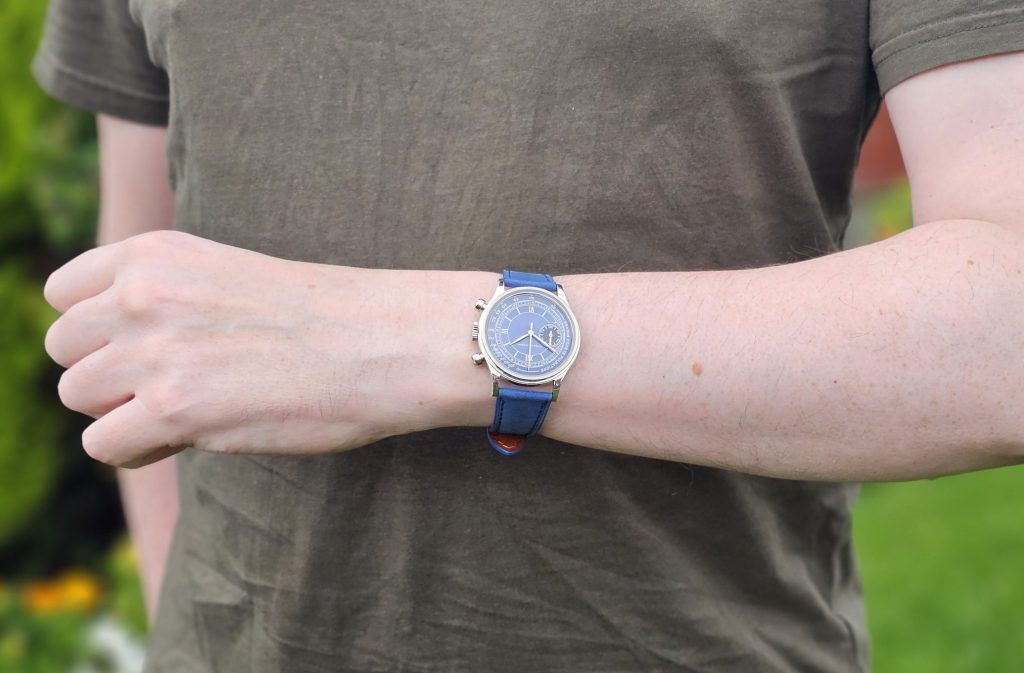
The case itself comes in at a very tidy 38mm, with the crown taking it to just 40.6mm at its widest point, while the 46mm lug-to-lug distance and 12mm thickness (if you include the 0.5mm domed crystal) make the watch a really versatile choice for most people. Sure, if you’ve got nine-inch wrists, it might not be suitable. Which is a shame, as that pulsometer would probably come in clutch for you. And yet, despite its demure dimensions, those prominent pushers, the stepped case and that protruding crystal give the watch a ton of presence and personality.
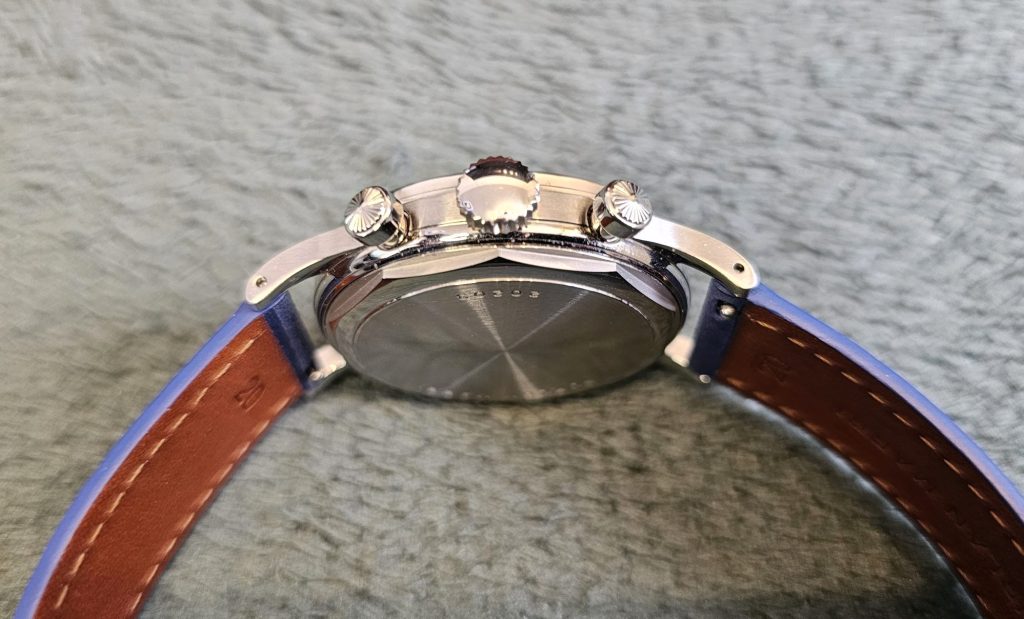
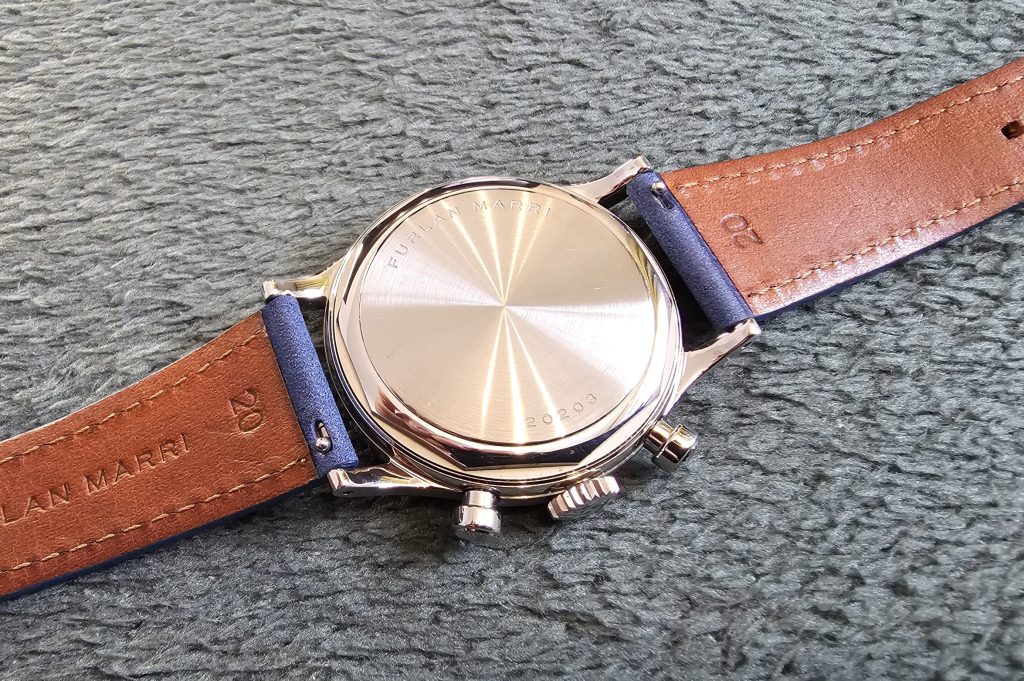
This makes the caseback something of an enigma. The plain, albeit brushed, back only shows the Furlan Marri name and the watch’s reference number (20203). No water resistance, no bragging about the sapphire crystal and no reference to the movement. The only flourish, and it’s more practical than aesthetic, is the ten-sided outer ring. This isn’t some bit of design whimsy. It means that the watch requires a specialised ten-sided tool to unscrew which is in keeping with what Patek Philippe and Vacheron Constantin used to use. Another nod to vintage horology. Mr Furlan and Mr Marri know their stuff.
A good reason for the plain case, as opposed to an exhibition one, is the movement. The Seiko VK64 is a meca-quartz hybrid movement and something of a workhorse for microbrand chronographs. The timekeeping is pure quartz, giving the watch that grab-and-go convenience. That may irk the purists and horology snobs, but you can file their complaints in the bin, frankly. Quartz is fine. Get over yourselves.
However, the chronograph function is mechanical. The top pusher starts it and engages a mechanical gear train that causes the chronograph seconds hand to sweep at 21600 vph. That uni-compax subdial ticks up minute by minute while using this functionality. The top pusher also stops the chronograph, while the bottom pusher activates an instant flyback reset with a satisfyingly sudden snap.
The only real issue with all of this is that when the chronograph isn’t engaged, the watch can feel very lifeless. That’s common with most chronographs unless they come with a small seconds hand. This is something the VK64 doesn’t support, though (although the VK63 and VK67s do). It’s not as if this is a nod to the 1463 either, as those had a bi-compax layout with a small seconds hand.
What you’re trading is a clean look for functionality, though, and it’s not a massive issue because the detailed minute track does give you a good idea of where you are between minutes.
A bigger, but understandable, compromise is that the VK64 is a date-enabled movement, which means you do get a ghost date position when setting it. This is, of course, tempered by the fact that the watch is quartz and so you’ll rarely have to use it. But again, it does break that illusion of Swiss quality. However, if you want all this lovely finishing with a more high-end movement, you could probably add a zero to the end of the price. Indeed, Furlan Marri have used Swiss-made Sellitas in their higher-end watches, but for the consumer that’s a pretty expensive solution to such a small problem.
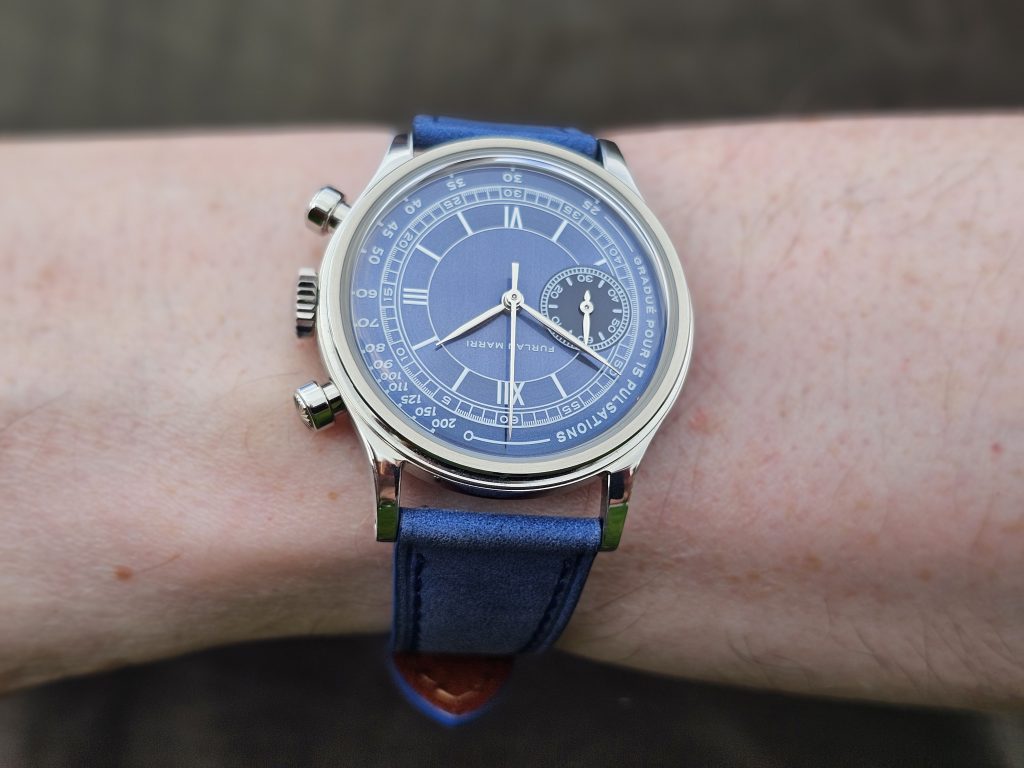
Our biggest niggle is that, as fans of lume, this watch has none. Those dainty hands and the PVD-coated dial haven’t left any room for it. Some may argue that lume isn’t really all that useful but, for us, it’s a nice thing to have. However, we’ve had no issues with legibility in medium-light environments.
The watch comes with two leather straps. The default blue nubuck is a perfect match for the dial, whereas the light (baby) blue is a little more casual. Both have a coloured outer layer, the blue being more velvety while the baby blue is smooth, and the inner lining is vegetable-tanned rather than dyed, which means that sweat doesn’t turn blue and start colouring your sleeves. It’s also more comfortable, breathable and non-allergenic. Both straps are extremely comfortable, with none of that awkward tension that leather straps can often torment us flat-wristed folk with.
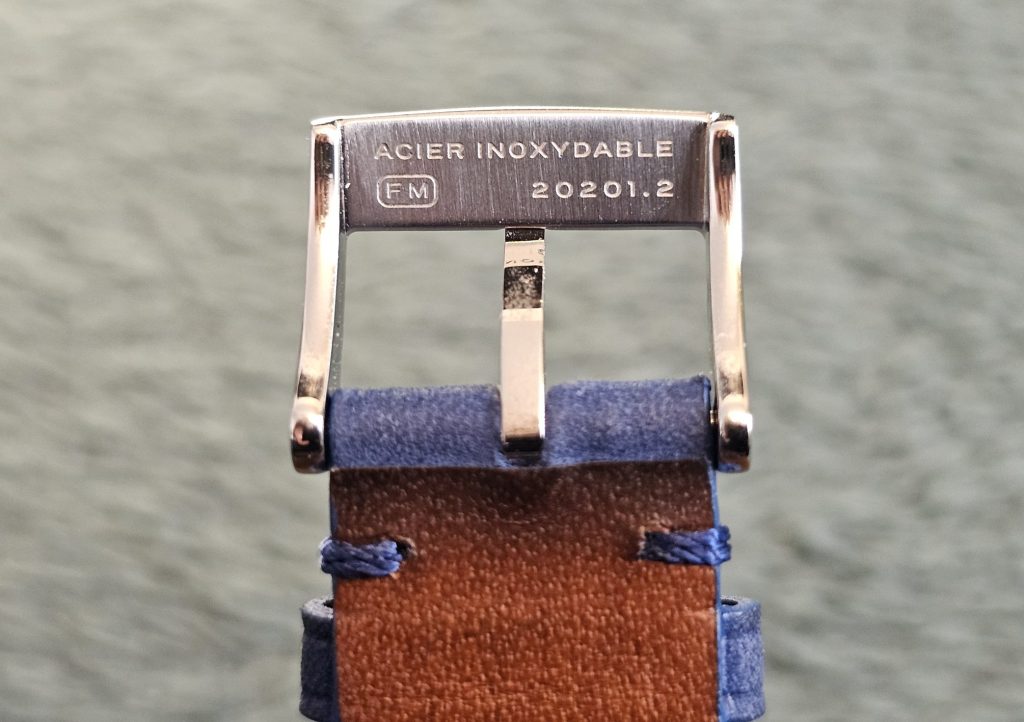
Both straps are branded and feature quick-release spring bars. We never doubted you, Furlan Marri, but we’re glad to see it and, genuinely, switching over these straps is probably the easiest in over thirty reviews. And the buckles are signed on top and stamped underneath with ‘Acier Inoxydable’ (Stainless Steel in French) along with ‘FM’ (which may as well say FML after I googled what it stood for which is, of course, Furlan Marri’) and a reference ‘20201.2’ which is an internal reference that translates as ‘202’ which designates this is in the 38mm Meca-Quartz range, ‘01’ which denotes that it is a pin buckle and ‘.2’ which is a bit of version control.
The thing is, the initials and the material are a little nod to history, as individual component makers used to do that all the time, with Furlan Marri deliberately continuing a tradition that goes back to companies such as Gay Fréres and Wenger, who came up with these little industrial fingerprints when producing parts for brands like Patek Philippe.
As you can see, for every compromise that Furlan Marri have had to make (and there really aren’t many), they have gone above and beyond in crafting the elements that they could control. For that price (around £530/$717), you get a perfectly functional meca-quartz chronograph that is absolutely packed with thoughtful, impressive touches that give the watch real artistry while also linking directly to the heritage of Swiss chronographs. Every element, every layer, every surface. They all sing their own song while perfectly harmonising with the rest of the watch.
This is elite design at a mid-range microbrand price. And as long as you don’t go looking inside the case, this watch really does hold its own with pieces that cost thousands of pounds more. And it’ll cost a lot less to service when the time comes.
4.0 out of 5.0 stars
Pros:
+ Meaningfully references history
+ Exceptional finishing
+ The domed crystal creates some interesting distortions
+ High-quality, comfortable straps
+ The pulsometer scale is cooler, and more useful, than a tachymeter
Cons:
– The VK64 movement is a very basic option
– Ghost date
– No lume
– Looks lifeless when not using the chronograph
Summary:
The Seiko movement may be a necessary compromise to keep the price down, but if you can ignore that, this watch exhibits some of the best finishing we’ve seen at this price range and it references horological history in a way that shows respect but stops short of straight homage.
JUST THE FACTS
Availability/Options: The Ardesia Blu is a permanent fixture in the Furlan Marri line-up and is joined by four other variants that mix up the colours and layouts.
Brand: Furlan Marri.
Model: Ardesia Blu
Style: Chronograph
Case Size: 38mm
Movement: Seiko VK64 (mechaquartz)
Material: 316 Stainless Steel
Lug Width: 20mm
Band Type: Leather strap (two included)
Price: £530
Nope, not for me
Loved the review as usual though